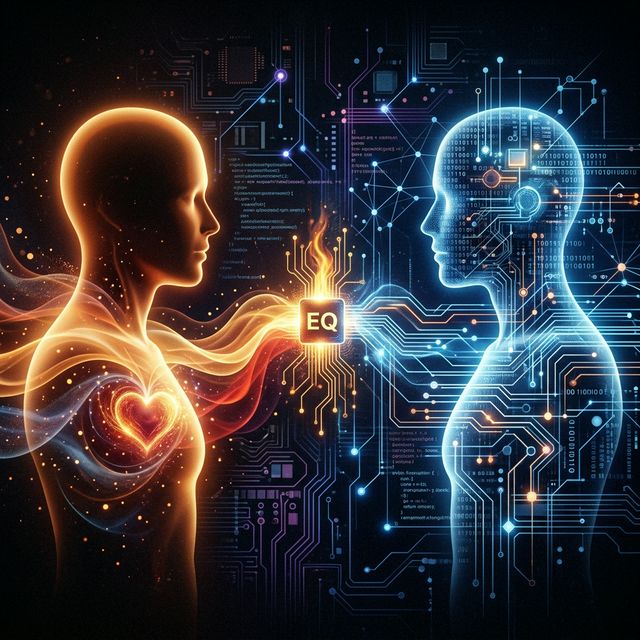
As artificial intelligence systems grow increasingly capable of performing technical tasks — writing code, analyzing data, generating reports, even diagnosing medical images — a counterintuitive trend is emerging in the labor market. The skills that are hardest for AI to replicate are becoming the most valuable. Soft skills, long dismissed as the 'fuzzy' complement to hard technical abilities, are now the hardest currency in the professional economy.
The Data Behind the Soft Skills Premium
The World Economic Forum's Future of Jobs Report identifies creativity, analytical thinking, and adaptability as the three most important skills for workers by 2027. This is not aspirational hand-waving — it reflects concrete shifts in hiring patterns. Employers are increasingly screening for emotional intelligence, communication ability, and collaborative capacity alongside (or even ahead of) technical credentials.
McKinsey's research reinforces this shift with a striking finding: 70% of jobs that are most resistant to automation require strong interpersonal skills. These are not just customer-facing roles. They include management, strategic planning, cross-functional coordination, and any position where navigating ambiguity and building consensus are central to the work.
The salary data tells the same story. Professionals who score in the top quartile for communication and leadership skills earn 20% to 35% more than peers with equivalent technical credentials, according to a 2024 analysis by Burning Glass Technologies. The soft skills premium is not new, but it is accelerating.
Which Soft Skills Matter Most
Not all soft skills are created equal. The highest-value competencies in an AI-augmented workplace cluster into three categories. First, complex communication: the ability to explain technical concepts to non-technical stakeholders, negotiate competing priorities, and write with precision and persuasion. AI can generate text, but it cannot read a room.
Second, adaptive problem-solving: the capacity to navigate novel situations where there is no playbook, to synthesize information from disparate domains, and to make judgment calls under uncertainty. These are the moments where experience, intuition, and creativity converge — and where AI systems, trained on historical patterns, are weakest.
Third, relational intelligence: the ability to build trust, manage conflict, mentor others, and lead diverse teams through change. As organizations flatten and cross-functional collaboration becomes the norm, the capacity to influence without authority has become a career-defining skill.
How to Develop Soft Skills Deliberately
Unlike technical skills, which can often be learned through courses and certifications, soft skills develop primarily through practice and feedback. The most effective approaches combine structured learning with real-world application. Toastmasters and similar programs build communication skills through repetition. Executive coaching accelerates leadership development by providing external perspective. Cross-functional projects force adaptive problem-solving by placing you outside your domain of expertise.
One underrated strategy is deliberate role expansion. Volunteer to lead a project standup, facilitate a retrospective, or present a quarterly review to leadership. These are low-risk environments where you can practice high-stakes skills. The key is to treat soft skill development with the same intentionality that you would bring to learning a new programming language or earning a certification.
Future-Proofing Through Human Skills
The irony of the AI revolution is that it is making us more human, not less. As machines handle the predictable, pattern-matching work that once defined professional competence, the distinctly human capacities — empathy, creativity, judgment, persuasion — are moving from the periphery to the center of professional value.
Workers who invest in soft skills today are not just hedging against automation. They are positioning themselves for the roles that will matter most in an AI-augmented economy: the roles that require a human in the loop not because the technology is insufficient, but because the work itself is fundamentally human. In the age of AI, the softest skills are the hardest to replace — and the most valuable to cultivate.